Discover The Perfect Staircase Style For You
Have you ever wondered what type of staircase would best suit your home? Or how different designs can impact the look and feel of your space?
In this post, you’ll learn about twelve popular types of staircase designs and their unique benefits and drawbacks.
By the end, you’ll have a clear understanding of which staircase style is the best fit for your stair remodeling project.
Types of Stairs in a House
| Staircase Type | Description |
|---|---|
| Straight Staircase | A single linear flight of steps with no change in direction, simple to build and commonly found in residential and commercial spaces. |
| L-shaped (Quarter-turn) Staircase | Features a 90-degree turn with a landing, adding visual interest and fitting neatly into corners. |
| U-shaped (Switchback, Half-turn) Staircase | Two parallel flights connected by a landing, forming a U shape that is both functional and elegant. |
| Winder Staircase | A variation of the L-shaped design that uses wedge-shaped steps instead of a landing to turn the corner and save space. |
| Curved Staircase | A continuous, sweeping staircase without landings, creating an elegant architectural focal point. |
| Spiral Staircase | Steps spiral tightly around a central pole, making it ideal for compact spaces. |
| Bifurcated Staircase (Split) | A wide flight that splits into two narrower flights in opposite directions, often seen in grand entrances. |
| Open or Floating Staircase | Has open risers with treads that appear to “float,” creating a light, airy, and modern look. |
| Closed Staircase | A staircase with risers, giving a traditional, sturdy appearance and a more enclosed feel. |
| Cantilever Stairs | Treads appear to float with hidden or exposed support, creating a dramatic and modern effect. |
| Storage Staircase | Incorporates cabinets, shelves, or drawers beneath the steps for added functionality. |
| Ladder Staircase | A single linear flight of steps with no change in direction, simple to build, and commonly found in residential and commercial spaces. |
12 Different Types Of Staircases
1. Straight Staircase

A straight staircase is the most straightforward of all of the kinds of stairs, featuring a single linear flight of steps with no change in direction. This type of staircase is commonly found in both residential and commercial buildings due to its simplicity and ease of construction.
Advantages:
- Easy to ascend/descend: Straight stairs tend to be the simplest for daily use.
- Simple construction and minimal support: Requires less structural support, making it easier to build.
- Suits minimalist designs: Its straightforward design complements modern, minimalist homes.
- Transparent with thinner treads and open risers: Offers an unobstructed view and adds a sense of space.
Disadvantages:
- Requires significant linear space: Needs a lot of horizontal space, which may not be practical for all floor plans.
- No privacy barrier: Does not provide separation between floors.
- Landing required for heights above 12 feet: For taller structures, building codes require a central landing.
2. L-shaped (Quarter-turn) Staircase

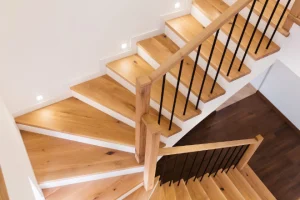
The L-shaped staircase, also known as the quarter-turn stair, incorporates a 90-degree turn, usually with a landing. This type of staircase can add visual interest and fit nicely into the corners of a home.
Advantages:
- Visually interesting: The turn adds an architectural element that enhances the overall design.
- Adds privacy between floors: Creates a visual barrier that can separate different levels.
- Reduces sound transmission: Helps muffle noise between floors when enclosed by walls.
- Central landing for safety and rest: The landing provides a resting point and can make the staircase safer.
- Fits well in corners: Utilizes corner spaces efficiently, making it space efficient.
Disadvantages:
- More complex to build: Requires more planning and construction effort compared to straight stairs.
- Requires support for landing: The landing needs structural support, which can add to the complexity.
- More challenging handrail construction: Designing handrails for L-shaped stairs can be tricky.
3. U-shaped (Switchback, Halfback, Half-turn) Staircase
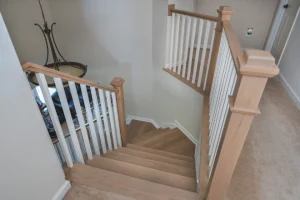
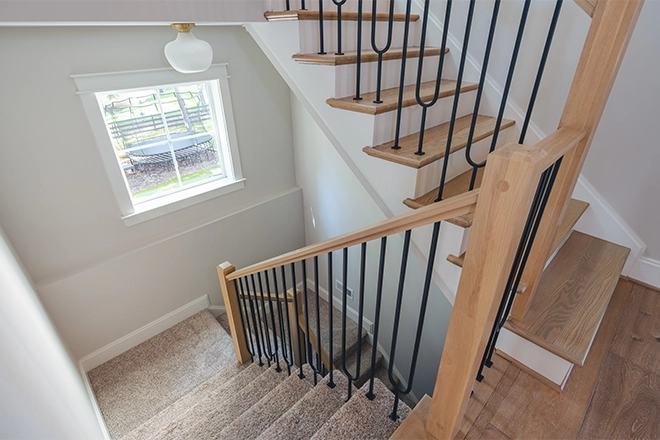
U-shaped stairs, also known as switchback stairs or half-turn stairs, consist of two parallel flights of stairs connected by a landing, forming a U shape. This design is functional and can be visually appealing.
Advantages:
- Easier to fit into architectural plans: The compact design fits well into many layouts.
- Offers architectural interest: Adds a sophisticated look to the home.
- Landing provides a resting point: Makes the staircase more comfortable to use.
Disadvantages:
- More difficult to build: The design and construction are more complex than simpler stair types.
4. Winder Staircase
Winder stairs are a variation of the L-shaped staircase but replace the landing with wedge-shaped stairs that turn the corner. This design saves space and can be visually seamless.
Advantages:
- Space-saving: Takes up less space than other types of stairs.
- Visually seamless transition: Creates a smooth and continuous look.
- Popular in modern and sustainable designs: Favored for contemporary and eco-friendly homes.
Disadvantages:
- Harder to navigate: The wedge-shaped steps can be tricky to use.
- Challenging handrail construction: Adding handrails can be more complex.
- Requires center support: Needs structural support at the turning point.
5. Curved Staircase

Curved staircases have no landings and follow a smooth, continuous curve. Much like the sweeping architecture of Alexandria’s Carlyle House, curved stairs add elegance and a dramatic focal point to any home.
Advantages:
- Adds elegance and visual appeal: Makes a striking architectural statement.
- Easy to walk up with a large radius: Comfortable to use if the curve is gentle.
Disadvantages:
- Most difficult and costly to build: Requires expert design and craftsmanship, making it one of the most expensive options.
6. Spiral Staircase
Spiral staircases are compact, featuring steps that spiral around a central pole. They’re perfect for small spaces, much like the tucked-away historic rowhouses near Old Town Alexandria.
Advantages:
- Compact design: Ideal for areas where space is limited.
- Attractive with various railing styles: Can be customized with different railing designs.
- Minimal support structures needed: The central pole provides the necessary support.
Disadvantages:
- Difficult to navigate and carry large items: The narrow steps can be challenging.
- Not suitable as primary access to upper floors: Better for secondary or auxiliary use.
- Limited to one person at a time: Only allows one person to ascend or descend at a time.
Discover more about the pros and cons of spiral staircases.
7. Bifurcated Staircase (Split Staircase)
Bifurcated staircases start with a single, broad flight that splits into two narrower flights leading in opposite directions. They evoke the same sense of grandeur you’d find walking into Vienna’s Wolf Trap Center for the Performing Arts during a gala evening.
Advantages:
- Functions as two staircases leading to different sections: Provides access to separate areas from one point.
- Impressive architectural statement: Adds grandeur to any home or building.
- Suitable for large homes or commercial buildings: Ideal for spacious areas.
Disadvantages:
- Requires significant space: Needs a large footprint.
- More expensive: Higher costs due to the complex design and additional materials.
8. Open Or Floating Staircase
Floating stairs have open risers, creating an airy and modern look. The treads appear to “float” without visible support.
Advantages:
- Modern and minimalist appeal: Perfect for contemporary homes.
- Creates an open and airy feel: Enhances the sense of space and light.
Disadvantages:
- It may lack stability without proper support: Requires careful design to ensure safety.
- It can be more expensive due to design complexity: Higher construction costs.
Want to know more about floating staircases?
9. Closed Staircase
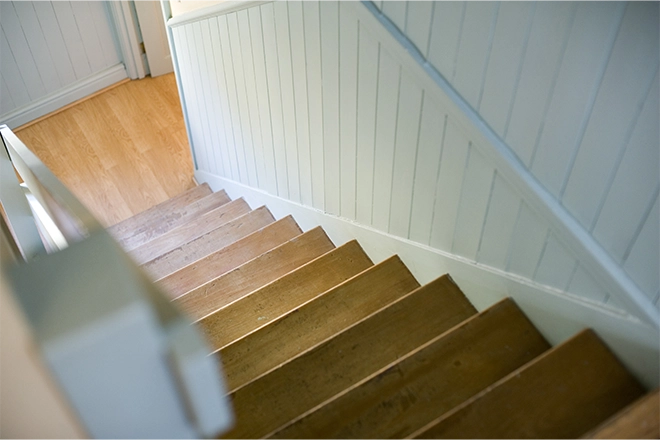
Closed staircases have risers, giving a traditional and sturdy appearance. This staircase type is familiar and widely used.
Advantages:
- Provides stability and safety: Solid design makes it safe to use.
- Traditional and familiar design: Fits well with many architectural styles.
Disadvantages:
- It can look bulky and less modern: It may not suit contemporary interiors.
- Limits visibility through the staircase: Blocks the view and light.
10. Cantilever Stairs
A cantilever staircase has treads that appear to float with hidden or exposed support. This design is unique and striking.
Advantages:
- Unique and visually interesting: Adds a wow factor to any home.
- More headroom: Open design creates more space.
- Open and spacious aesthetic: Enhances the overall feel of the room.
Disadvantages:
- Requires structural considerations for support: Needs careful planning and design.
- Costly due to additional structural requirements: Higher expenses for construction.
11. Storage Staircase
Storage staircases utilize the space under the stairs for storage, incorporating shelves, cabinets, or drawers.
Advantages:
- Utilizes space efficiently: Maximizes storage in small areas.
- Provides additional storage solutions: Great for homes needing extra storage.
Disadvantages:
- Design complexity can increase costs: Custom designs are more expensive.
- May require custom construction: Needs tailored building solutions.
12. Ladder Staircase
Ladder stairs are simple and compact, making them the ideal stair type for tight spaces or small homes.
Advantages:
- Most compact: Takes up minimal space.
- Cost-effective: Simple design reduces costs.
- Movable or foldable for space-saving: Can be stored when not in use.
- Useful for high shelves: Perfect for accessing high storage areas.
Disadvantages:
- Difficult to navigate, especially descending: Ladder staircases are less stable and harder to use.
- Not suitable as a primary staircase: Best for occasional use or secondary access.
What Staircase Type Is Right For Your Home?
Choosing the right staircase style for your home can be a daunting task, given the wide range of options available. To make the best decision, consider the following factors: functionality, budget, and space.
Evaluating Functionality
Primary Use: Determine whether the staircase will be a primary or secondary means of access. For example, a spiral staircase might be suitable for a secondary staircase but not ideal for main access due to its compact design and narrow steps.
Safety Considerations: If you have young children or elderly family members, safety becomes a crucial factor. Straight staircases and U-shaped stairs with landings provide safer options.
Ease of Navigation: Straight stairs are the easiest to navigate, while winder stairs and spiral stairs can be more challenging. Consider who will be using the stairs most frequently and choose accordingly.
Budget Considerations
Cost of Construction: Some staircase styles, like curved staircases and bifurcated stairs, are more expensive due to their complex designs and the need for skilled craftsmanship.
Material Costs: The choice of materials can significantly impact your budget. Straight stairs with wooden treads are typically less expensive than floating stairs made with glass or metal.
Maintenance Expenses: Consider the long-term maintenance costs. For instance, wooden staircases might require periodic refinishing, while metal or glass staircases could need less frequent upkeep.
Do you want to know the cost of a staircase remodel in Fairfax, VA?
Space Requirements
Available Space: The amount of space you have will largely dictate the kinds of stairs you can choose. Straight staircases require more linear space, while spiral staircases and winder stairs are more space-efficient.
Architectural Fit: Ensure the staircase style complements the overall architectural design of your home. A modern home might benefit from the sleek look of a floating staircase, while a traditional home could look best with a classic L-shaped staircase.
Potential Modifications: If space is limited, consider creative solutions like a storage staircase, which utilizes the space beneath the stairs for storage, or alternating tread staircases, which are designed for tight spaces.
By carefully evaluating these factors, you can select a staircase style that not only enhances the aesthetic appeal of your home but also meets your practical needs and budget constraints.
Additional Resources For Stair Projects
To help you further in your staircase design journey, here are some additional resources that can provide valuable insights and guidance.
Types Of Stair Treads
Understanding the different types of stair treads is essential for choosing the right materials for your staircase:
- Wood Treads: Offers a classic and warm look, suitable for most home styles.
- Metal Treads: Provides a modern and industrial feel, often used in floating stairs.
- Glass Treads: Adds a contemporary and sleek appearance, ideal for minimalist designs.
- Stone Composite and Tile Treads: Durable and stylish options that can match various interior themes.
Choosing Wood For Stair Treads
When selecting wood for your stair treads, consider the following:
Hardness and Durability: Hardwoods like oak, maple, and walnut are durable and resistant to wear.
Grain and Color: Choose a wood grain and color that complements your home’s interior design.
Sustainability: Opt for sustainably sourced wood to reduce environmental impact.
Selecting Top Rail
The top rail is an important aspect of your staircase design.
Match the top rail with the overall aesthetic of your staircase. Wood, metal, and glass are common choices.
Ensure the top rail is comfortable to grip and meets safety standards.
Explore custom designs to add unique character to your staircase.
Don’t forget about the different types of banisters to choose from!
Put The Stair In Your Staircase With Stair Creations
At Stair Creations, we specialize in transforming homes with our expert staircase designs and installations. Our team in Fairfax, VA, can handle any project, from simple straight stairs to elegant curved staircases.
Don’t wait to elevate your home’s style and functionality. Fill out our contact form today, or give us a call to get started on your dream staircase!