
Navigating Residential Stair Code Requirements in Our Area
Have you ever wondered what building a safe and compliant staircase in your home takes? Or how those steps in your house might need to measure up to local laws?
In this post, you’ll learn the key requirements of the staircase building code in Fairfax, VA.
By the end, you’ll be equipped with the knowledge to ensure your Fairfax staircase installation project meets legal standards and keeps your home safe and sound.
What is the Building Code for Stairs?
- Stairways must be at least 36 inches (914 mm) in clear width above handrail height.
- Clear width with handrails must be no less than 31½ inches (787 mm) on one side and 27 inches (698 mm) on both sides.
- Minimum headroom clearance must be 6 feet 8 inches (2032 mm), measured vertically from the tread nosing to the ceiling.
- Vertical rise between floor levels or landings shall not exceed 151 inches (3835 mm).
- Walkline for winder treads must be 12 inches (305 mm) from the inside of the turn.
- Riser height must not exceed 8¼ inches (210 mm).
- Risers must be uniform in size, with a maximum variance of 3/8 inch (9.5 mm) within a flight.
- Open risers are allowed if openings do not allow a 4-inch diameter sphere to pass through.
- Tread depth must be at least 9 inches (229 mm), measured horizontally from the tread’s leading edge to the vertical plane of the next tread.
- For winder treads, the minimum tread depth at the walkline must be 10 inches (254 mm), with a minimum of 6 inches (152 mm) at the narrowest part.
- Nosings must project between 3/4 inch (19 mm) and 1¼ inches (32 mm) from the tread.
- Nosings’ radius of curvature must not exceed 9/16 inch (14 mm).
- Enclosed space under stairs must be protected with 1/2-inch (12.7 mm) gypsum board.
- Stairways must have artificial light capable of illuminating treads and landings to at least 1 foot-candle (11 lux).
- Stairways with six or more risers must have a wall switch at each floor level, unless the lighting system is centrally controlled or automated.
Parts of a staircase explained.
Stairway Dimensions and Layout

Stairway Width Requirements
One of the most fundamental aspects of the staircase building code is the width of your stairway.
In Fairfax, VA, stairways shall not be less than 36 inches (914 mm) in clear width. This required width ensures that the stairway is spacious enough to accommodate people comfortably, even in an emergency.
The minimum width applies to the space above the handrail height, ensuring there’s ample room for safe passage.
When handrails are installed, the clear width can be slightly reduced to not less than 31½ inches (787 mm) on one side and 27 inches (698 mm) on both sides.
This balance between safety and practicality ensures that your stairway is both accessible and compliant with the local building code.
Stairway Headroom Clearance
No one wants to bump their head while climbing stairs, which is why headroom clearance is critical.
The minimum headroom clearance in Fairfax, VA, must be at least 6 feet 8 inches (2,032 mm) measured vertically from the tread nosing to the ceiling.
This ensures that even taller individuals can use the stairs comfortably without worrying about low ceilings.
For those planning to install spiral stairways, the headroom clearance requirements differ slightly, reflecting the unique design and space-saving nature of these stairs.
Always ensure that you account for headroom when planning your staircase layout, as this can impact both safety and comfort.
Stairway Vertical Rise
Another key measurement in the staircase building code is the vertical rise.
In Fairfax, VA, the vertical rise between floor levels or landings shall not exceed 151 inches (3835 mm).
This restriction helps maintain a comfortable and safe gradient for the staircase, ensuring that the stairs aren’t too steep and are easier to climb.
How big does a landing need to be?
Stairway Walkline Requirements
For stairways that include winder treads, the placement of the walkline is essential.
The walkline should be 12 inches (305 mm) from the inside of the turn, following a concentric path parallel to the direction of travel.
This placement helps maintain consistent tread depth, which is crucial for preventing missteps and ensuring a smooth transition through turns.
Stair Treads and Risers
Stair Riser Height
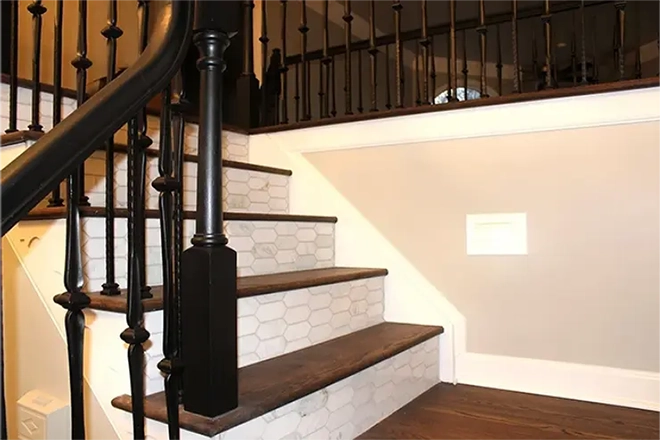
In Fairfax, VA, the riser height—the vertical distance between adjacent treads—must not exceed 8¼ inches (210 mm).
This measurement is vital in maintaining a comfortable and safe step height.
The risers must also be uniform in size, with the difference between the tallest and shortest riser within a flight of stairs not exceeding 3/8 inch (9.5 mm).
Open risers are permitted under certain conditions, but the openings must be small enough that a 4-inch diameter sphere cannot pass through if the stairway is more than 30 inches above the floor or grade below.
This ensures that the stairs are safe, especially in homes with small children.
Stair Tread Depth
Tread depth is another critical aspect of staircase design.
The tread depth in Fairfax, VA, must be at least 9 inches (229 mm), measured horizontally from the tread’s leading edge to the vertical plane of the next tread.
Consistency is key here, with the difference in depth between the largest and smallest tread within a flight not exceeding 3/8 inch (9.5 mm).
For winder treads, which are often used in curved or spiral staircases, the minimum tread depth at the walkline must be 10 inches (254 mm). The depth at the narrowest part of the tread shall not be less than 6 inches (152 mm).
This ensures that each step is safe and stable, even in tighter spaces.
Stair Nosings
Nosings—the overhanging edge of the tread—play an important role in the staircase’s safety and usability.
- Nosings must project between 3/4 inch (19 mm) and 1¼ inches (32 mm) from the tread.
- The nosing’s radius of curvature must not exceed 9/16 inch (14 mm) to avoid tripping hazards.
- Nosings also need to be uniform within a stairway, with the difference between the largest and smallest nosing projection not exceeding 3/8 inch (9.5 mm).
Uniformity helps to create a predictable walking surface, reducing the risk of accidents.
Under-Stair Protection
When it comes to staircase building code, Fairfax, VA, doesn’t cut corners, especially with spaces that might often be overlooked, like the area under your stairs.
According to the International Residential Code (IRC), any enclosed space under stairs that is accessible by a door or panel must be protected with 1/2-inch (12.7 mm) gypsum board.
This crucial step helps prevent fire from spreading rapidly through your home by reinforcing a potential weak spot in your staircase design.
Protecting this space isn’t just about meeting building codes; it’s about safeguarding your home and your loved ones. With the right materials in place, you add an extra layer of security that could make all the difference in an emergency.
Interior Stairway Illumination
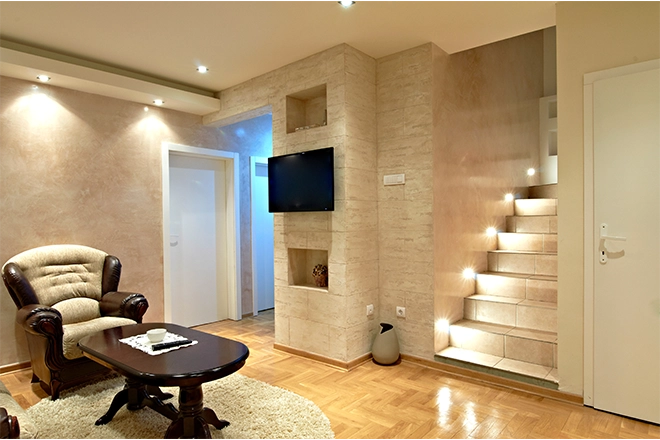
Imagine navigating your staircase in the dark—seems risky, right?
That’s why the staircase building code in Fairfax, VA, mandates proper illumination for all interior stairs.
Stairways must have an artificial light source capable of illuminating the treads and landings to at least 1 foot-candle (11 lux). This ensures that every step is clearly visible, reducing the chances of trips or falls.
But it’s not just about the brightness.
The code also requires stairways with six or more risers to have a wall switch at each floor level. This ensures you can control the lights from either end of the stairs, adding both convenience and safety to your home.
The only exception to this rule is if your lighting system is centrally controlled or automated.
How to avoid staircase design mistakes.
Ensure Your Stairs Are up to Code With Stair Creations
Stair Creations is your go-to expert for navigating the staircase building code in Fairfax, VA, ensuring your stairway is both beautiful and compliant. Let us handle the complexities of installation so you can enjoy peace of mind and a safe, stunning staircase.
Ready to upgrade your stairs? Fill out our contact form today, or give us a call to get started on a staircase that meets all local codes and exceeds your expectations.