
Get a Grip on Stair Rail Know-How
Ever walked up a staircase and wondered what’s keeping you from tipping over the edge? Or noticed a sleek railing design and thought, “Wait—is that for looks or safety?”
In this post, you’ll learn exactly what a stair rail is, what parts it includes, how it’s different from a handrail, and which materials and styles are best for your space.
By the end, you’ll be confident that Stair Creations knows what they’re doing when working on your stair railing project.
What Is a Stair Rail?
A stair rail is a safety barrier installed along the open side of stairs or landings to prevent falls. It typically includes a handrail for support and vertical balusters to block openings. Stair rails are required by building codes and form a critical part of the overall railing system.
Key functions of stair rails:
- They act as a safety boundary on the open side of staircases or landings.
- Depending on the design, they may include a handrail gripping surface for people who need help.
- They often use balusters to prevent people from slipping through gaps.
Most building codes require stair rails in places where falls could occur.
Understanding what is a stair rail starts with safety—but it doesn’t end there. Its construction and style can also add to your home’s aesthetic appeal and structure.
Contact us today about your stair railing project.
Parts of a Staircase Railing System
Handrail (or Banister)
The handrail is the part your hand touches when you climb or descend the stairs.
It runs along the angle of the staircase and may be attached to a wall or supported by balusters or newel posts.
A handrail must be easy to grip, without sharp edges or breaks.
Many building codes require a continuous handrail that lets your hand slide without interruption. The handrail must also be at an appropriate height—usually between 34 and 38 inches. It must also be shaped for comfort and control, either with a circular cross-section or a code-approved noncircular cross-section.
Balusters (Spindles or Pickets)
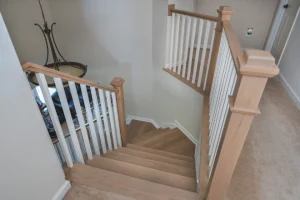
Balusters, or spindles, are the vertical posts that hold up the handrail and fill in the space between the handrail and the stair treads or floor.
They’re not just decorative—they help prevent falls, especially for children or pets.
Building codes typically require that balusters be spaced close enough that a 4-inch sphere can’t pass between them.
Newel Posts
Newel posts are the larger, sturdy posts that anchor the railing system.
They’re typically supported at the bottom, top, and turns of the staircase and carry much of the weight and tension of the stair rails.
While they provide safety and structure, newel posts are often a place for added design, with many homes choosing carved wood or iron for extra detail.
Base Rail
The base rail sits at the bottom of the balusters and runs horizontally along the treads or floor.
Some staircases don’t use a base rail at all and instead insert balusters directly into the steps for a more streamlined look.
Skirtboard and Apron
The skirtboard is a trim piece that runs along the wall next to the staircase. It’s cut to match the angle of the stairs and helps give the stairs a finished appearance.
The apron is a trim board found beneath open staircases or landings, especially under glass railings or open-sided designs. It hides the floor edge and ties the stair’s look together.
The other parts of a staircase.
Stair Rail vs. Handrail – What’s the Difference?
Purpose
Stair rails are mainly to prevent people from falling off the edge of stairs or landings. They serve as a barrier, especially on open staircases.
Handrails are meant to provide stability by giving people something to hold onto while using the stairs or ramp surfaces. Their main job is to support the user as they move.
Functionality
Stair rails act as guardrails. They may include a handrail, but the handrail isn’t always required.
Handrails must allow a power grip. That means the user can fully wrap their hand around the surface, not just rest it on top. This type of grip provides better control, especially when descending stairs.
Design Requirements
Stair rails can be more flexible in design. They may or may not include a handrail and may use different materials, such as glass or horizontal rails, depending on the local code.
Handrail requirements are stricter.
The handrail must be continuous without gaps or breaks along the walking surfaces. Most codes require that it be installed between 34 and 38 inches in height and meet size rules. This includes either a circular cross-section with a specific outside diameter or an approved non-circular cross-section.
What about a railing vs. a banister?
Material Options for Stair Rails
Wood
Natural wood is a classic choice that adds warmth to traditional or craftsman-style homes.
It can be painted or stained to match your design vision, and there are many customization options available. However, it may require more maintenance than metal.
Iron
Iron stair rails offer strength and design variety.
They can be simple or ornate and work well for both indoor and outdoor applications. Iron is also a great choice if you want to combine durability with aesthetic appeal.
Wood and Iron Combinations
Using wood for the handrail and newel posts and iron for the balusters creates a balanced look. This mix works especially well in rustic or transitional spaces.
Glass Panels
Glass railings are a popular choice for modern spaces.
They open up sightlines and make the stairway feel more spacious. They often need extra engineering to stay secure and meet building codes, especially when used without a supporting frame.
Of course, glass stair railings have their pros and cons.
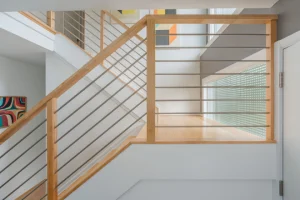
Cable Railings
Cable railings use tensioned steel cables that extend horizontally through posts.
They create a clean, modern look that suits industrial or open-concept homes. Be aware that they may need regular tightening and that horizontal rails are not allowed in all areas due to safety concerns.
Common Stair Rail Styles
Vertical Balusters
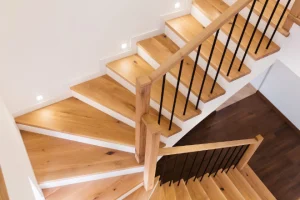
This is the most traditional option and also the most widely accepted by building codes. Vertical balusters run from the base to the handrail and work well with nearly every design.
Horizontal Balusters
These balusters extend horizontally and create a sleek, modern look. They’re common in newer builds but may be restricted in some locations due to climbability concerns, especially in homes with young children.
Railings Without Base Rails
This style skips the base rail and inserts the balusters directly into the stair treads or landing. The result is a streamlined look that can complement both classic and modern interiors.
Floor-to-Ceiling Railings
These tall stair rails stretch from the floor to the ceiling, often doubling as room dividers. They can serve both a structural and decorative role and are especially effective in large, open-plan homes.
From First Step to Finishing Touch, Stair Creations Delivers
At Stair Creations, we craft staircase railing systems that are just as strong as they are stylish. From custom stair rails to detailed handrails and newel posts, we bring precision and personality to every installation.
Ready to bring your staircase vision to life? Fill out our contact form today or give us a call—we’d love to help you take the next step.