Rise with the Curve
Thinking about adding a staircase that actually makes the room instead of just moving you through it? Curious what makes curved staircases feel so upscale—and whether they’re even practical for your space?
In this post, you’ll learn what curved staircases really are, the different types available, their design benefits, and how they’re built.
By the end, you’ll know whether a curved staircase is the right fit for your staircase installation—and exactly why these architectural showpieces turn heads (and corners).
What Is a Curved Staircase?
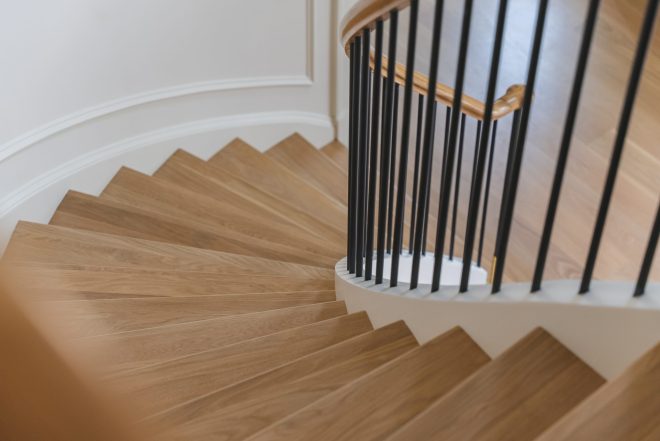
A curved staircase is a staircase that follows a smooth, continuous arc instead of straight lines or sharp angles. It lacks a central column and turns gently, unlike spiral or L-shaped stairs. Curved stairs provide visual elegance while guiding foot traffic naturally in homes or buildings with open floor plans.
Contact us today about your staircase installation.
Types of Curved Staircases
Helical Stairs
Helical stairs are the most modern form of curved staircase.
They don’t have a central support post like spiral stairs, but still curve around an invisible center point. The structure is typically supported by curved stringers or nearby walls.
This type of stairway works well in contemporary design because it feels open and sculptural. It also allows for more freedom in layout, especially when floor space is tight.
Elliptical Stairs
Elliptical stairs are designed with an oval footprint, not a perfect circle.
The shape feels softer and more organic than traditional curved designs and fits beautifully into homes with a more classic architectural style.
They often appear in luxurious settings where the staircase is meant to be a focal point.
Circular Stairs
Circular stairs complete a full or partial 360° turn but don’t have a central column.
The top tread curves gently into the second floor, and the structure often blends with the surrounding architecture. This type of curved staircase feels formal and symmetrical. It’s ideal for large entryways or gallery-style layouts.
What about other types of staircases?
Why Choose a Curved Staircase?
Aesthetic Appeal That Transforms a Room
A curved staircase offers instant visual impact.
Its rounded silhouette stands out in any room, turning what’s usually a utility into something closer to art. The smooth curve draws the eye upward, creating a sense of height and motion that can dramatically enhance the overall appearance of your home.
Customization for Any Space
Curved stairs are almost always custom-built, which gives you control over materials, radius, railing, and stair design ideas.
Whether you’re after traditional wood with decorative handrails or a sleek steel frame with glass railings, the options vary depending on your layout and taste. Since each design adapts to your exact floor plan, curved stairs often make better use of space than straight stairs in tricky layouts.
Comfort and Safety
The wider tread depth and gradual curve of curved stairs make them more comfortable to use than steep or narrow alternatives.
Their steady incline is easier on the knees, and the design encourages smooth movement from floor to floor. Unlike a spiral staircase, which can feel tight or unstable, curved stairs feel sturdy and welcoming, even for older adults or kids.
Functional Flow and Space Efficiency
These stairs don’t just look good—they support the natural flow of movement in a home.
A curved staircase can guide people smoothly from the main level to the second floor without sharp turns or wasted corners. Since they don’t rely on landings or angular breaks, they can be surprisingly space-efficient in the right layout.
How Curved Staircases Are Designed and Built
Planning the Layout
Designing curved stairs starts with calculating the total rise between floors and dividing that by the ideal riser height.
Most builders use the inside radius for layout, since it defines the arc and space most accurately.
A full-scale drawing is often sketched directly onto the subfloor before construction begins. This helps visualize where the curved wall or stringer will land and how the stair will interact with walls, landings, and doorways.
Calculating Steps and Tread Layout
Once the number of risers is set, the tread layout follows.
Builders often use a story pole to ensure even spacing and double-check measurements from floor to finished floor.
Each step is carefully planned to maintain a consistent rise and comfortable walking rhythm along the curve.
Framing and Adjustments
Even with perfect math, some adjustments happen during framing.
The radius might shift slightly depending on nearby framing, stairwell size, or how the top tread meets the second floor.
Experienced builders use trammel points and trial layouts to get the arc just right, ensuring that each tread blends smoothly into the next.
Learn more about how to build a curved staircase.
Where Curved Stairs Work Best
Grand Entryways
A curved staircase is perfect for open foyers and front entrances, where it can be seen right away. It creates a powerful first impression, especially when paired with lighting, bold railings, or two-story ceilings.
Entryway staircase ideas that wow.
Multi-Level Homes With Flow
If your house has a wide footprint or multiple staggered floors, curved stairs can help connect levels while keeping traffic flowing naturally.
They’re great in layouts where straight stairs would feel too abrupt or blocky.
Commercial and Public Spaces
Curved staircases also show up in places like hotels, theaters, and museums.
There, they offer a mix of elegant style and practical flow, making it easy to move large groups between floors while still looking refined.
Handle the Curves Easily with Stair Creations
Stair Creations designs and installs stunning curved staircases throughout northern Virginia, bringing elegance and flow to homes of all shapes and sizes. Whether you’re remodeling an entryway or building a home, our team builds staircases that turn heads and elevate daily living.
Ready to transform your space with a stairway that blends form, function, and flair? Fill out our contact form today or give us a call.