Take It for a Spin
Thinking about installing a staircase that doesn’t just save space, but makes a serious statement? Wondering how spiral stairs actually work, what your options are, or if they’re even safe for everyday use?
In this post, you’ll learn what a spiral staircase is, how it’s built, the different types you can choose from, and what to expect with pros, cons, and safety info.
By the end, you’ll know whether a spiral staircase is the right move for your staircase installation—and exactly what to look for before making the leap.
What Is a Spiral Staircase?
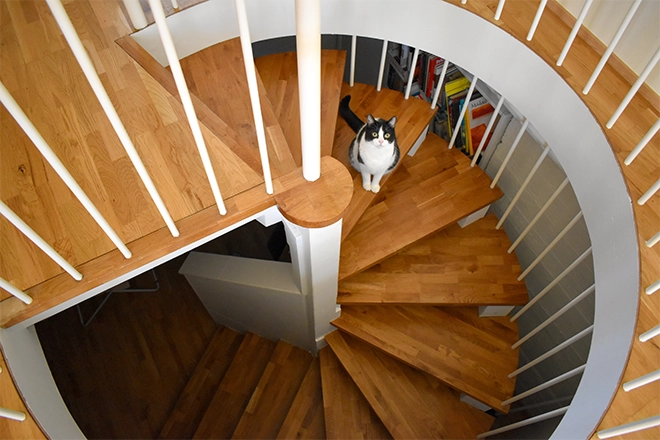
A spiral staircase is a vertical stair system where treads wrap around a central pole, saving floor space while connecting different levels. It is ideal for tight areas like lofts or decks due to its compact design and is commonly used in both indoor and outdoor settings.
Contact us today about your staircase installation.
Types of Spiral Staircases
Not all spiral stairs are the same. From sleek modern kits to classic ironwork spirals, there are several design options that can be the perfect solution to your project’s needs and your personal style.
Closed Shaft Spiral Staircase
These spiral staircases are enclosed within a cylindrical shaft and don’t leave the center open to view.
They’re often found in compact areas where you want to protect the center or hide structural elements. This makes them useful in industrial or apartment buildings where efficiency and function are key.
Open Spiral Staircase
This is the version most people imagine: a central pole, open steps, and plenty of visual space.
Open spirals allow light to flow through the room and can serve as a design centerpiece, especially with a modern or elegant finish.
Vertical Axis Spiral Stair
In this variation, the stairs hug a vertical pole tightly with little or no open space in the middle.
It’s a tight, minimal design that works well in narrow locations or for secondary access in a multi-level house.
Custom and Decorative Spiral Stairs
Custom spiral staircases let you choose from a range of materials, railing designs, and treads to match your house’s design. You can even customize the direction—turning right or left—to better suit your layout and maximize space.
What do spiral staircases cost?
Key Parts of a Spiral Stair
Understanding how a spiral staircase is built helps you know what to expect during planning and installation.
Center Column
The central post is the backbone of any spiral stair.
All of the treads attach to this column, and it carries the weight of the stair system. In many spiral staircase kits, this column is made of steel or aluminum for strength and durability.
Treads
These are the steps themselves, usually shaped like wedges or trapezoids.
They’re wider at the outside edge and narrower near the center. Treads can be made of wood, steel, composite, or even glass, depending on your design goals.
Base Plate
This plate anchors the center column to your floor. It’s pre-drilled in most kits to make installation quicker and easier.
Landing Platform
At the top of the stair, the landing creates a level space to step off of and onto the next floor. It connects the spiral to the upper level and usually matches the diameter of the stairs.
Handrail and Guardrails
For spiral stairs, the handrail is essential for stability and safety.
The rails curve around with the staircase, often as one continuous line, offering support as you navigate the turns. Many systems include platform rails at the top landing for added protection.
Pros and Cons of Spiral Staircases
Pros of a Spiral Staircase
- Saves floor space, especially in tight layouts.
- Works well for indoor stairs or outdoor applications.
- Comes in prefab kits or custom designs.
- Adds a stylish, architectural element to the house.
- Easier to ship and install than many traditional staircase systems.
- Some models are DIY-friendly with detailed instructions.
Cons of a Spiral Staircase
- Treads are often steeper than standard stairs, which can be uncomfortable for some.
- Not ideal for moving furniture or large items between floors.
- May not meet local building codes as a primary staircase.
- It can be harder for children, pets, or elderly individuals to use safely.
- Some users feel less comfort or stability due to narrower step widths.
Learn more about the ups and downs of spiral stairs.
Spiral vs. Helical Stairs
Spiral and helical stairs both have curves, but the way they’re built—and how they look—are completely different.
Spiral Stairs
These turn tightly around a central post. The design is compact, efficient, and cost-effective. Spiral staircase kits are widely available and can be installed in just a few weeks with the right tools.
Helical Stairs
Helical stairs are curved but have no center pole. They’re more open and elegant, but also more complex and expensive to build. These are typically seen in custom homes or commercial projects where style takes priority over efficiency.
What are the other types of staircases?
Spiral Staircase Safety and Code Considerations
Safety matters, especially when your stairs are used every day.
Most spiral staircases can’t serve as a home’s main stair due to fire escape regulations.
Check your local building code to see what’s allowed. This may include rules about minimum tread width, riser height, and handrail placement. For example, some codes require a 5-foot diameter spiral stair with a landing platform for second-story access.
Always confirm whether your spiral stair design will pass inspection before starting installation. Choosing the right system now can save you headaches later.
Put a New Twist on Your Home with Stair Creations
If you’re ready to install a spiral staircase in northern Virginia, Stair Creations has the tools, expertise, and design sense to make it happen. Whether your space is modern, rustic, or somewhere in between, we can customize your new stairs to fit your home perfectly.
To get started on your dream staircase, fill out our contact form today or give us a call. We’ll help you bring every step of your vision to life.