
Why L-Shaped Stairs Make Sense
Thinking about adding a staircase that fits your space better than a straight shot? Wondering if turning the corner—literally—is the right move for your home or building?
In this post, you’ll learn what an L-shaped staircase is, how it works, and why it’s one of the most practical and stylish stair designs around.
By the end, you’ll know whether this layout is the right one for your staircase installation.
What Is an L-Shaped Staircase?
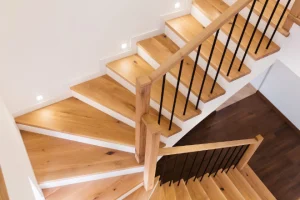
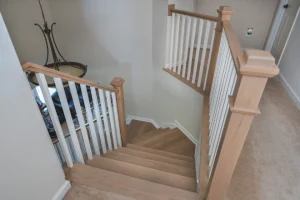
An L-shaped staircase is a stairway that changes direction 90 degrees at a landing or set of winders, forming an “L” shape. It is often used in homes with limited space because it fits better around corners or walls and increases safety by reducing the risk of long falls.
Contact us today about your staircase installation.
Key Features of L-Shaped Staircases
How They Work
An L-shaped stair breaks a single long flight into two shorter sections, connected by a landing. That landing acts as both a turning point and a rest stop, helping people ascend or descend more easily.
The turn can be created with a square platform or a pie-shaped set of winders. Winders are often used when a compact footprint is more important than wide landing space.
What Makes It Different
Unlike straight stairs, an L shape adds movement and dimension to the layout.
It helps block a direct line of sight between floors, which can act as a visual barrier for added privacy.
It also offers more options for staircase placement in a home, especially near exterior walls or in tight interior corners. Because of the shape, L-shaped staircases often feel more integrated with the overall floor plan.
Common Dimensions and Code Basics
Typical Widths
Most residential l shaped stairs have a minimum width of 36 inches. Wider designs around 44 to 60 inches are more common in modern homes.
These widths allow one or two people to comfortably use the stairs at the same time.
For public or commercial buildings, staircase design may require even more space to meet building codes. Some wider stairs will need additional handrails installed to meet safety rules, especially if the total width exceeds 60 inches.
Rise and Run Requirements
Just like with straight stairs, the rise and run of each step must be consistent.
The total vertical rise between floors will often determine whether a landing or winders are needed.
Building codes typically require a landing if the staircase exceeds 12 feet in height or 16 risers in one flight. That landing must be at least as wide as the stairs and should be flat and clear for safe movement.
Advantages of L-Shaped Staircases
Safer Than Straight Stairs
If someone trips while going down an L-shaped stair, the landing reduces how far they can fall.
This natural break in the staircase adds a safety benefit you won’t get from a long run of straight treads.
That makes it a smart choice for families with kids or older adults who may need a spot to rest while moving between floors.
Visually Appealing
The 90-degree turn adds interest to what might otherwise be a flat, straight staircase.
That makes it a great fit for modern designs where shape and layout are just as important as function.
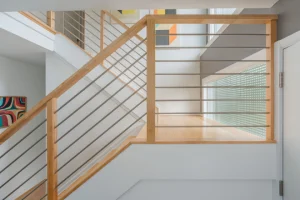
L-shaped stairs can also highlight features like open railings, angled walls, or unique lighting designs, making them a focal point of the space.
Flexible in Tight Spaces
These stairs are perfect for homes where there just isn’t enough room for a long, straight staircase.
The shape allows builders to tuck stairs along one wall and then turn to follow another, keeping the overall design efficient and compact.
The layout also makes it easier to avoid running into obstacles like windows, doors, or HVAC ducts.
Adds Separation Between Floors
An L shape creates a cleaner divide between levels. It helps reduce noise and visibility from one floor to the next.
This layout works especially well when the stairs are enclosed or sit between walls, adding extra sound control and privacy.
It’s a subtle but effective way to make an open floor plan feel more organized and structured.
Disadvantages to Consider
Requires More Planning and Framing
Compared to straight stairs, L-shaped stairs need additional framing for the landing or winders.
That might involve extra time and labor during the building process.
If structural support is needed under the landing, that also has to be factored into the design early on.
Can Increase the Overall Cost
The turn, added materials, and extra support structure all make L-shaped staircases more expensive to build.
The more complex the shape and finish, the higher the staircase cost tends to be.
Working with a skilled contractor can help keep the project on track and within budget while meeting all safety and building code standards.
Harder to Move Items Up and Down
While the turn is great for layout flexibility, it can make moving large objects like furniture a bit trickier.
You’ll need to take the corner carefully or have extra space at the landing for maneuvering.
In some cases, homeowners opt for wider treads or landings to make this easier.
Landing Design Options
Standard Square Landings
This is the most common type of landing in an L-shaped staircase.
They’re flat, rectangular platforms that create a clean and safe transition between the two flights of stairs.
A square landing is simple to frame and finish, making it a cost-effective choice for most projects.
Winder Stairs
Instead of a full landing, some staircases use winders—angled treads that form the turn without a platform.
These save space and can look visually interesting, but they’re not always as safe or code-compliant depending on your local rules.
Winders are often used in compact homes or designs where every inch of space matters.
Best Applications and Use Cases
Great for Homes with Limited Layout Options
If you’re working with a tight floor plan or trying to fit stairs into a corner, an L shape is ideal.
It lets you redirect the staircase without eating up too much usable space.
That makes it perfect for entryways, basements, or two-story additions where straight stairs won’t work.
Helps Divide Open-Concept Layouts
In homes with open layouts, an L-shaped staircase can help divide the space without putting up walls.
It adds shape and structure while maintaining a connected feel.
This kind of design adds interest without breaking the flow between living, dining, and kitchen zones.
Works in Commercial Spaces Too
You’ll also find L-shaped stairs in offices, retail buildings, and multi-use properties. They’re helpful for separating traffic flow, creating clean sightlines, or guiding movement in a particular direction. In many of these cases, the landing doubles as a spot to pause or redirect before reaching the next level.
Building and Installation Tips
Framing and Support Considerations
Make sure the floor and walls near the stairs are reinforced to handle the extra load. You’ll often need strong structural support under the landing and extra framing where the stair turns. A qualified contractor or designer can determine where and how to add that support safely.
Railing and Handrail Placement
Since the stair changes direction, you’ll need to plan for corner railings or wraparound handrails. These not only help people navigate the stairs but also ensure the stairway meets code. Look for stair railing materials that match the overall style of your home. Wood, metal, or glass are all popular choices in modern stair design.
Light It Properly
Corners and landings can get dark if they’re not well-lit. Add wall sconces, overhead lights, or even LED strips on the risers to keep the entire stairway safe and easy to use. Smart lighting helps prevent trips, highlights the stairs’ shape, and can be a beautiful feature in its own right.
What are the other types of staircases?
Help Your Stairs Turn the Right Corner with Stair Creations
If you’re ready to install a staircase that blends function, safety, and style, Stair Creations can make it happen. We design and build L-shaped staircases for homes and businesses across Northern Virginia, tailored to fit your space and your vision.
Let us help you create a staircase that works as beautifully as it looks—fill out our contact form today or give us a call. We’d love to talk about your project and how we can bring it to life.